
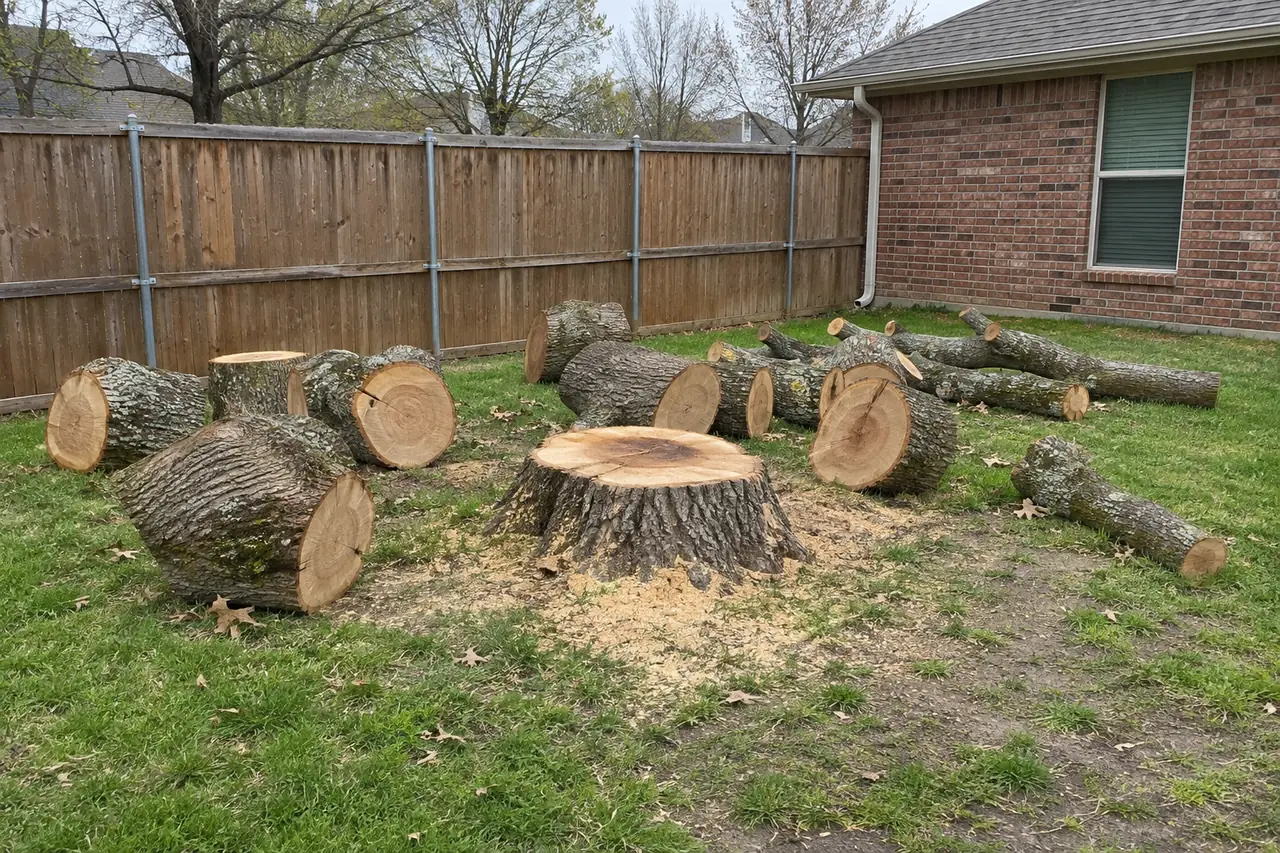
Why do trees at Midlothian homes come down?
Any of these problems can put a tree on the removal list. A tree has died outright, or half its crown has. A storm split a trunk or tore a main limb loose. An ash tree is thinning from the top down now that the emerald ash borer is confirmed in Ellis County. An oak weakened by drought has patches of dead bark. Or a tree planted close to the house when the subdivision was new has grown out over the roof.
Each of those has its own page: dead and dying trees (ash borer, drought, hypoxylon canker and root rot), hail and storm damage, and trimming for the cases where cutting back is enough.
Is a built home lot treated differently from a building site?
Yes. Midlothian's tree provisions are part of its zoning ordinance's landscaping standards. The residential section, Sec. 3.5400, applies to single-family detached and duplex zoning and sets the trees each lot must have. The nonresidential section, Sec. 4.5400, is written for land being developed: Sec. 4.5401 applies it to new construction in nonresidential districts, multifamily included, and Sec. 4.5409 calls for a landscape plan for any use other than single-family dwellings. Here is how it sorts out, read on Nov 15, 2026 from the city's eCode360 text of Sec. 3.5400 and Secs. 4.5401-4.5411:
| Situation | What the code does | Section |
|---|---|---|
| Existing single-family home, tree coming out | No removal permit, protected-tree size or mitigation charge in the residential section (checked Nov 15, 2026). If the tree is one of the trees the code requires on the lot, it must be replaced with plant material of similar variety and size. | Secs. 3.5401(e), 3.5402 |
| New house being built | Minimum trees by lot size (two front-yard shade trees on lots under 9,000 sq ft; three plus an ornamental from 9,000 to 14,000 sq ft), at least 3 caliper inches, planted before final building inspection | Secs. 3.5401-3.5403 |
| Commercial or multifamily building site | Approved landscape plan before building, paving or grading permits; saved trees earn credits by trunk circumference | Secs. 4.5402, 4.5408 |
| Tree at a street or alley corner | The nonresidential standards, written for new nonresidential and multifamily construction, let trees stand in intersection visibility triangles only if trimmed so no limbs reach into the band 3 to 6 feet above grade. The residential section keeps new trees out of intersection sight triangles. | Secs. 4.5403, 3.5401(b) |
If you'd like the city to confirm for your own address, the Planning department is at (972) 775-7161 or planning@midlothian.tx.us, at City Hall, 215 N. 8th Street (staff directory; checked Nov 15, 2026). The full reading is on the Midlothian tree ordinance page.
What does Texas law say about taking down a dead or dangerous tree?
Texas Local Government Code §212.905 sets limits on what any Texas city can do about tree removal. Under subsection (h), when a tree is dead, diseased, or poses an imminent or immediate threat to people or property, a city generally can neither forbid its removal nor attach a tree mitigation fee to it. Under subsection (b), a city generally can't charge that fee at all for a tree whose trunk measures less than 10 inches across at 4.5 feet, if it stands at the owner's existing one- or two-family home. The section was added by House Bill 7 in 2017 and took effect Dec 1, 2017 (checked Nov 15, 2026).
Since Midlothian's landscaping sections set no removal fee for a homeowner to begin with (Sec. 3.5400; checked Nov 15, 2026), the state law is mostly a backstop here. It matters more if you own land in a town with a stricter tree rule.
What changes when a power line runs through the tree?
Depending on where you live in Ellis County, the wires may belong to Oncor, HILCO Electric Cooperative or Navarro County Electric Cooperative. Whoever owns them, Texas Health and Safety Code Chapter 752 bars work in which a person moves or is placed within six feet of a high-voltage overhead line (over 600 volts), unless the line operator is notified at least 48 hours ahead and safety arrangements such as de-energizing or barriers are agreed first. Someone whose work causes contact with a line can be held liable to the line's owner for the damage (checked Nov 15, 2026).
Oncor splits the job this way (Vegetation Management page and Tree Pruning FAQ; checked Nov 15, 2026):
- Lines running pole to pole: Oncor's work only. To remove a tree near the line between two poles, ask Oncor for a "Make Ready" prune at 888-313-6862.
- The service line from the pole to your meter: the owner's to keep clear. Oncor can temporarily lower it, requested through your retail electric provider or Oncor, for what it calls a nominal charge.
- A tree within 10 feet of lines that looks hazardous: report it at 888-313-6862, weekdays 8 a.m. to 6 p.m. Central. Downed lines and outages: 888-313-4747, any hour. Sparking or fire: 911.
Mention any line in your request so the contractor can plan for it. More on clearances is on the trimming page.
How do Blackland clay and buried lines change the job?
The yard itself is part of the work. Houston Black, a dominant soil of the northern Blackland Prairie, has a black clay surface about 24 inches thick that shrinks and swells markedly with moisture and cracks open when dry (USDA NRCS and Texas Water Development Board; checked Nov 15, 2026). Ask how the crew plans to get a loader, chipper or grinder to the tree and what it will do if the lawn is soft after rain.
Under the surface are the lines you can't see. Texas Utilities Code Chapter 251 counts disturbing soil 16 inches deep or more as excavation and requires notice to the 811 center at least 48 hours ahead, not counting weekends and holidays. When you hire someone to dig, Texas811 says making that call is the contractor's job (checked Nov 15, 2026). The stump grinding page covers the details.
How does a removal unfold from first cut to cleanup?
Every tree is different, but a removal at a house generally goes in roughly this order:
- A look and a price. The contractor sizes up the tree, what's under it, how equipment reaches it and where the pieces can land, then gives a written price.
- Calls before cuts. Any line within reach is sorted out with the electric provider, and any digging is cleared through 811.
- Taking the crown apart. With open lawn on every side, a tree may be dropped in one piece. Over a roof, fence or patio, limbs usually come off in sections, the heavy ones lowered on rope.
- The trunk. What's left is cut down in rounds, like the oak in the photo above.
- Stump. Left a few inches high, or ground below grade once the utility marks are in, if that was part of the price.
- Brush and logs. Chipped, hauled, bundled for city pickup or left for you, as agreed.
Where do the logs and brush go in Midlothian?
Inside city limits, Waste Connections is the city's contracted hauler, and its brush pickup has firm limits: bundled and tied, branches no longer than 3 feet and no more than 6 inches across, each bundle under 35 pounds, up to 2 cubic yards per pickup day, out by 7 a.m. (City of Midlothian Trash & Recycling page and FAQ; checked Nov 15, 2026). That handles trimmings, not a whole tree. For more, residents can call Waste Connections at (972) 937-8836 for a special pickup it bills directly, and the city's FAQ says roll-off containers must come through Waste Connections (City Code 13.06.003).
The city pages don't address a tree crew hauling off its own cuttings, so ask whether hauling is in the price. Burning the brush at a city home is generally ruled out by state air rules in Ellis County; the brush and burning page explains why. And if the tree is an ash, plan to keep the wood close: the Ellis County emerald ash borer quarantine restricts moving ash material out of the county, and Texas A&M Forest Service advises disposing of dead ash where it stands rather than moving it (Texas Department of Agriculture, USDA Forest Service and Texas A&M Forest Service; checked Nov 15, 2026).
What does removal cost around Dallas?
HomeGuide lists typical tree removal in Dallas at $320 to $2,100, and Angi lists $475 to $875 for Dallas. Nationally, This Old House puts the average at $906 and ranges from $150-$450 for a tree 30 feet or shorter to $1,000-$2,000 for one 80 feet or taller (all checked Nov 15, 2026). Those are published ranges, not Midlothian prices. The cost page breaks out the add-ons.
More removal questions from Midlothian homeowners
The neighbor's tree hangs over my roof. Can I have it taken down?
Not on your own. The Texas State Law Library says Texas has no statute on this, but courts have let a neighbor trim branches and roots back to the property line; you can't go past the line, kill or cut down the tree, or go onto the neighbor's land without permission unless the branches are an imminent threat (updated Mar 8, 2024; checked Nov 15, 2026). The State Bar's disaster manual adds that a tree owner may be responsible for removing a dead or diseased tree before a storm brings it down.
Who pays if a healthy tree falls in a storm?
Under Texas common law, damage from a healthy tree knocked down by a storm is generally treated as an act of God, while an owner who left a dead or diseased tree standing may be liable (State Bar of Texas Disaster Manual on TexasLawHelp.org; checked Nov 15, 2026). The Texas Department of Insurance says many home policies cover damage when a tree falls on the house; claim steps are on the storm page.
Does it matter if the tree is under 10 inches thick?
Only where a city charges tree mitigation fees. At an owner's existing one- or two-family home, §212.905(b) generally bars that fee for a tree under 10 inches in diameter at 4.5 feet (checked Nov 15, 2026).
To have someone look at the tree, call (469) 537-4905 or use the request form. Whichever you use, it reaches one independent contractor serving Midlothian and Ellis County, who looks the tree over, prices the removal and does the work.