
Where are Midlothian's tree rules written?
In the zoning ordinance's landscaping sections. Those are where the city's code puts its tree language, and the city's Building Permits & Inspections page lists no tree permit (checked Nov 15, 2026); the Planning department, (972) 775-7161, can say whether anything else applies to a particular lot. The base zoning ordinance is Ordinance 2013-24, adopted July 9, 2013. Two landscaping sections carry the tree language (checked Nov 15, 2026):
| Section | Covers | History |
|---|---|---|
| Sec. 3.5400 (3.5401-3.5403) | Residential landscaping for single-family detached and duplex zoning: minimum trees per lot (Sec. 3.5402) and replacement of required plantings (Sec. 3.5401(e)) | Read in the city's official code on eCode360 (code version dated July 14, 2026) |
| Sec. 4.5400 (4.5401-4.5411) | Nonresidential Landscaping and Streetscaping Standards | Replaced in full by Ord. 2014-34, adopted Aug 26, 2014 |
| Sec. 4.5404 | Recommended and prohibited plant list | Amended by Ord. 2017-75, adopted Oct 10, 2017; read in the official code on eCode360 |
| Sec. 4.5408 | Credits for preserving existing trees, within the nonresidential standards | Ord. 2014-34 (Aug 26, 2014), amended by Ord. 2017-75 (Oct 10, 2017); read in the official code on eCode360 |
A note on sources: Sec. 3.5400 (eCode360) and Sec. 4.5400, Secs. 4.5401 through 4.5411 (eCode360), were all read in the city's official code (checked Nov 15, 2026).
What does Sec. 4.5400 cover, and why doesn't it reach a backyard?
Because it's written for development. Sec. 4.5401 applies the standards to new construction in nonresidential districts, multifamily included, and states their purpose as promoting property values, the general welfare and the city's appearance. Sec. 4.5402 requires an approved landscape plan before building, paving, grading or construction permits are issued, and Sec. 4.5409 requires a landscape plan for any use other than single-family dwellings. Enforcement under Sec. 4.5411 starts with a 30-day notice to restore approved landscaping, after which it is treated as a violation of Section 1.50 of the zoning ordinance (checked Nov 15, 2026).
That chain is written for development, not for a homeowner removing a tree from an existing single-family lot: as of Nov 15, 2026, Sec. 4.5400 sets no protected-tree size threshold, removal permit or mitigation charge (eCode360, official code).
Which trees does the city recommend, and which can't count toward required planting?
Sec. 4.5404 sorts trees into two lists. Trees on the prohibited list "shall not be used to fulfill the planting requirements" of the ordinance (Sec. 4.5404, eCode360; checked Nov 15, 2026).
| Recommended (others need the Planning Director's approval) | Prohibited for required planting |
|---|---|
| Live oak Bur oak Cedar elm Texas ash Bald cypress Pecan Shumard red oak Texas redbud | Arizona ash Bois d'arc Cottonwood Siberian elm Silver maple Mimosa Mulberry Lombardy poplar Chinese tallow Arborvitae All willows |
Planting sizes under the same section: overstory trees at least 4 caliper inches, measured 12 inches above the base, and 7 feet tall; accent trees at least 1 caliper inch and 5 feet tall. The prohibited list governs which trees count toward a planting requirement, and the residential section points single-family lots to the same approved list for their required trees (Sec. 3.5401(b), eCode360; checked Nov 15, 2026). Neither list orders an existing mulberry or cottonwood out of a yard.
How does the tree credit table work?
Sec. 4.5408, part of the nonresidential landscaping and streetscaping standards, lets a developer count existing trees that are kept toward the trees the landscape rules require. In the code's words, trees preserved on a site "may be credited toward meeting the tree requirement" (Sec. 4.5408, eCode360; checked Nov 15, 2026). The table measures the trunk's circumference, the distance around it, 4.5 feet above the ground, not its diameter:
| Circumference at 4.5 ft | Counts as |
|---|---|
| 6 to 8 inches | 1 tree |
| 9 to 30 inches | 1½ trees |
| 31 to 46 inches | 2 trees |
| 47 inches and up | 3 trees |
For scale, a trunk with a 6-inch circumference is less than 2 inches across. Trees off the approved list can earn credit only with City Council approval. If a tree designated for preservation in a landscape plan dies, the owner must replace it with one or more trees of at least 4 caliper inches.
What does the residential section ask of a single-family lot?
Sec. 3.5400 applies to single-family detached and duplex zoning (Sec. 3.5401(a)); planned development and overlay districts with their own landscaping standards follow those instead. Sec. 3.5402 sets the minimum trees per lot, read from the city's official code on eCode360 (checked Nov 15, 2026):
- Lots under 9,000 square feet: 2 front-yard shade trees.
- Lots of 9,000 to 14,000 square feet: 3 front-yard shade trees and 1 ornamental tree.
- Lots over 14,000 and up to 20,000 square feet: 3 front-yard shade trees and 2 ornamental trees.
- Where the rear yard backs onto a city thoroughfare other than a local street, two or three overstory trees in the rear yard as well, by lot size.
- Required trees at least 3 caliper inches at planting, measured 6 inches above the ground, and planted before the final building inspection; no certificate of occupancy until the landscaping is in (Sec. 3.5401(d)).
- No trees in utility easements or rights-of-way, where the mature canopy will interfere with overhead lines, within 10 feet of a fire hydrant, or in intersection sight triangles (Sec. 3.5401(b)).
- Credits for preserving protected trees, as Sec. 4.5408 defines them, can count toward the residential and buffer tree requirements.
The part that stays with the lot after move-in is Sec. 3.5401(e): plant material that is damaged, destroyed or removed "must be replaced with plant material of similar variety and size" (checked Nov 15, 2026). That is a duty to replace, not a permit to remove. If the tree you want gone is one of the lot's required front-yard trees, plan on putting in a similar one.
Does any city rule touch trimming on a built lot?
Only at corners, and not directly. The closest is Sec. 4.5403 in the nonresidential standards: trees may stand in the visibility triangles at street and alley intersections only if they're trimmed so no limbs or foliage reach into the cross-visibility band between 3 and 6 feet above grade. Those standards apply to new nonresidential and multifamily construction (Sec. 4.5401, eCode360), while the residential section keeps new trees out of intersection sight triangles (Sec. 3.5401(b), eCode360) (both checked Nov 15, 2026). Separately, the city's code enforcement rules cap weeds, grass and brush at 12 inches on a property (Ordinance 2011-42; City of Midlothian Common Violations page; checked Nov 15, 2026), which matters on an overgrown lot more than for a yard tree. Code Enforcement is at (469) 672-0970.
What does Texas Local Government Code §212.905 add?
It limits what any Texas city can require when trees come out (official text; checked Nov 15, 2026):
- Dead, diseased or dangerous trees, subsection (h): a city generally can't forbid taking down a tree that's dead or diseased, or one that's an imminent or immediate danger to people or property, and can't charge a tree mitigation fee for it.
- Small trees at your home, subsection (b): at an existing one- or two-family home the owner lives in, a city generally can't charge a mitigation fee for a tree whose trunk is less than 10 inches thick 4.5 feet up.
- Planting credits, subsections (c), (d) and (f): where a city does charge a fee, the owner may apply for a credit for planting replacement trees at least 2 inches in diameter at 4.5 feet; at an existing owner-occupied one- or two-family home the credit equals the full fee.
The section was added by House Bill 7 in 2017 and took effect Dec 1, 2017. Since Midlothian's landscaping sections set no removal fee for a homeowner (Sec. 3.5400; checked Nov 15, 2026), the statute is mostly a backstop here.
How do Midlothian, Waxahachie and state law line up?
| Where | Removal permit for a built home lot | What the tree rules do cover | How existing trees are measured |
|---|---|---|---|
| Midlothian | None in Secs. 3.5400 or 4.5400 | Minimum trees per single-family lot, with required plantings replaced if damaged, destroyed or removed (Secs. 3.5401(e), 3.5402); landscape plans for nonresidential and multifamily building (Sec. 4.5400) | Circumference at 4.5 ft, for credits |
| Waxahachie | None in Sec. 5.04, which covers new building | Sec. 5.04 for new nonresidential and multifamily building; canopy trees for new homes (three 2-inch trees per home in SF1, one in SF2 and SF3) | Diameter at breast height: 6 to 12 inches earns 1 credit, over 12 inches earns 2 |
| Outside city limits | No tree ordinance on Ellis County's list of county ordinances and policies, and no tree section in its Subdivision and Development Standards, which count "clearing of land" as development that usually requires a county permit or approval. Ask the Ellis County Department of Development, (972) 825-5200, before clearing acreage. | ||
| Texas, every city | §212.905 generally bars bans on, and mitigation fees for, removing dead, diseased or imminently dangerous trees, and mitigation fees for trees under 10 inches at an owner's home. | ||
Who at City Hall answers tree questions?
City Hall is at 215 N. 8th Street, Midlothian, TX 76065. From the city's staff directory and building inspections page (checked Nov 15, 2026):
- Planning: (972) 775-7161, planning@midlothian.tx.us. Start here for anything about the zoning ordinance or a landscape plan.
- Building Inspections: (972) 775-7161, inspection requests (972) 775-7166, weekdays 8 a.m. to 5 p.m. Its page doesn't mention tree permits.
- Code Enforcement: (469) 672-0970.
- Public Works / Streets: 972-775-1083.
Questions about Midlothian's tree rules
Do I have to plant a new tree if I take one out?
Only if the tree was one of the trees the code requires on your lot, in which case Sec. 3.5401(e) calls for a replacement of similar variety and size (eCode360; checked Nov 15, 2026).
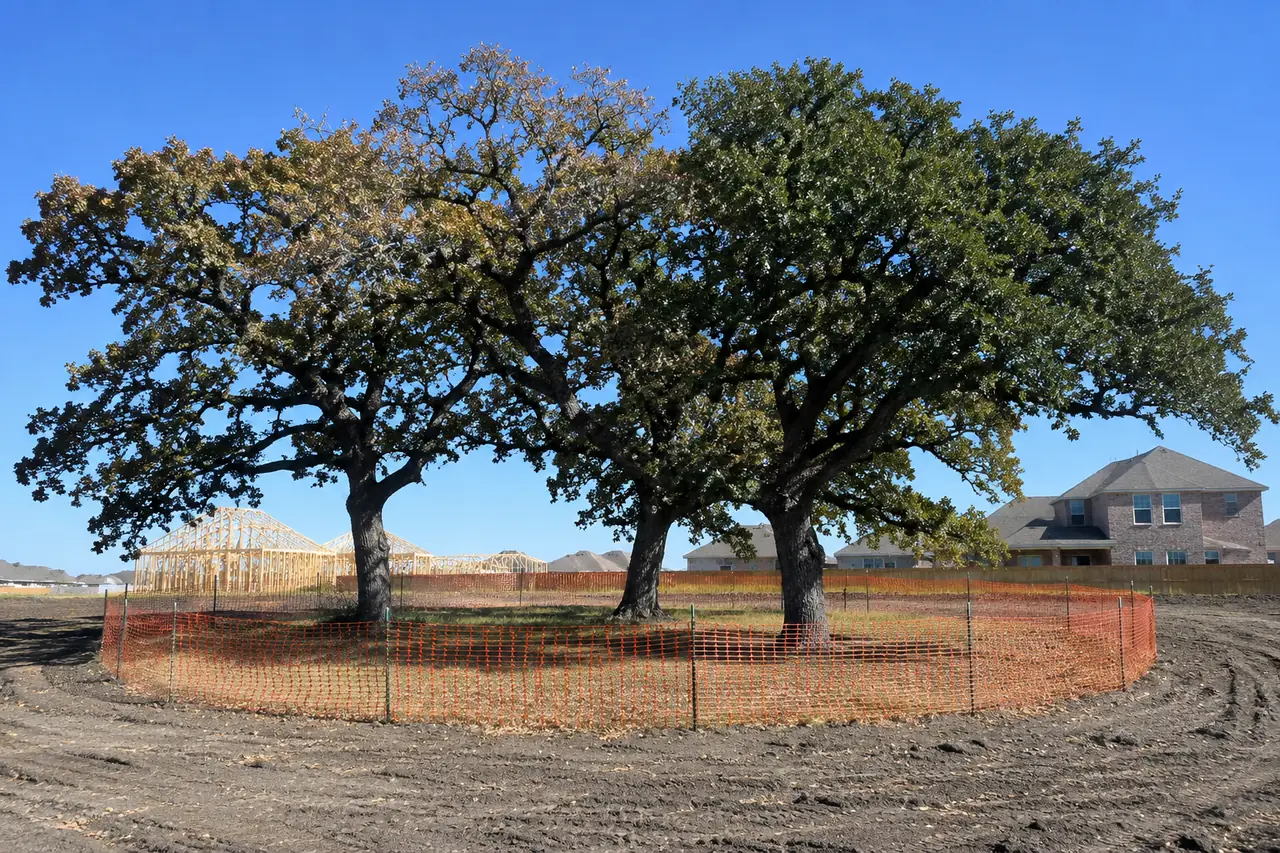
My builder left an old oak during construction. Is it protected now?
Possibly in one way. The residential section lets credits for preserved trees count toward a lot's required trees, so if the builder counted that oak as one of your front-yard trees, removing it could bring the replacement rule into play. Beyond that, the residential section's tree rules are the lot minimums, where trees may be planted and the replacement duty (Sec. 3.5400, eCode360; checked Nov 15, 2026). Planning can tell you how your lot was approved.
Is a dead tree treated differently?
Under §212.905(h), a city generally can't stop you from removing a dead or diseased tree or charge a mitigation fee for it. See dead tree removal for what's killing trees in Ellis County.
When you're ready to have a tree looked at, call (469) 537-4905 or use the request form. It lands with one independent contractor who works in Midlothian and around Ellis County; that contractor sees the tree, prices it and handles the job. Related: tree removal and brush and burning rules.