
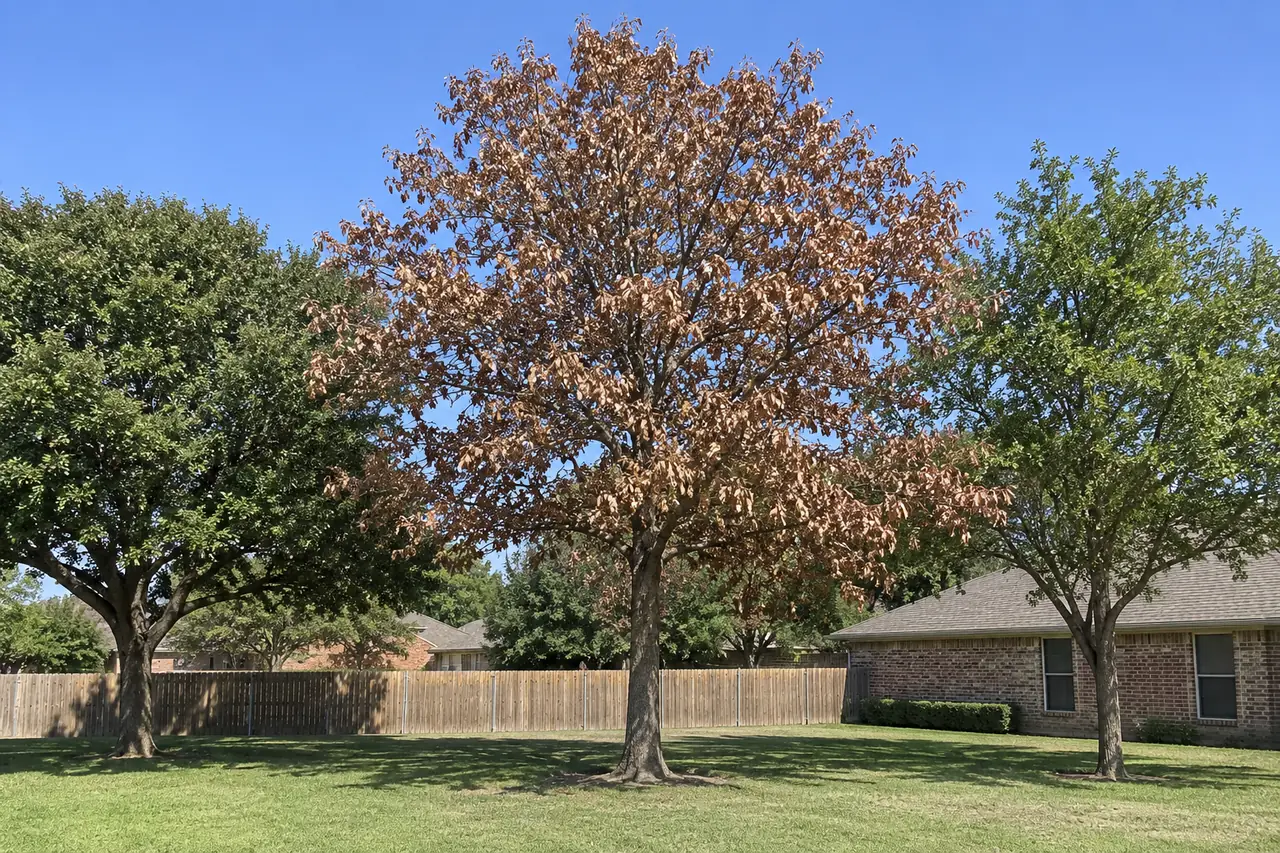
Is the emerald ash borer in Ellis County?
Yes. Texas A&M Forest Service's county list reads "As of June 2026, there are 40 confirmed Texas counties with EAB," and Ellis is on it, along with its neighbors Dallas, Tarrant, Johnson, Navarro and Hill. The insect was first found in Texas in Harrison County in 2016 (checked Nov 15, 2026).
The state has responded with a quarantine. The Texas Department of Agriculture's notice reads: "07/09/2024. The Ellis County Quarantined Area is hereby established." The quarantine runs under TDA Rule §19.701, and the current map is dated July 22, 2026. The USDA Forest Service's 2025 Texas report says state quarantines restrict moving ash material out of the county. TDA's own line on firewood: "Prevention of the movement of infested firewood is a critical tool" (checked Nov 15, 2026).
How can you tell an ash tree is infested?
Texas A&M Forest Service lists these signs (checked Nov 15, 2026):
- Dead branches near the top of the tree.
- Leafy shoots sprouting from the trunk.
- Splits in the bark that show S-shaped tunnels left by the larvae.
- Extensive woodpecker activity on the trunk.
- D-shaped exit holes in the bark.
- The adult beetle: dark green, about half an inch long.
Early infestations often show no outward symptoms at all. The Forest Service's EAB hotline is 1-866-322-4512.
Can an infested ash be saved, or does it come down?
Where the borer is present, Texas A&M Forest Service recommends a systemic insecticide (emamectin benzoate); injections protect a tree for 2 to 3 years, and adults fly roughly from May through June (checked Nov 15, 2026). Ask whether treatment makes sense for your tree's condition.
For an ash that's dead, the wood itself is the concern. The Forest Service says the insect can survive up to two years in cut wood and advises chipping, burning or burying dead ash wood on site. Its firewood rule is short: "Leave firewood at home. Do not transport firewood, even within the state." In Ellis County, burning is tightly limited by state air rules (see brush and burning), so ask the contractor how the ash wood will be chipped or otherwise kept on site.
What has drought done to trees here?
The USDA Forest Service's 2025 Forest Health Highlights for Texas reported that "Texas experienced severe drought conditions over FY 2025," and that the February 2025 cold also did significant damage (checked Nov 15, 2026). Drought matters here partly because of the ground: the Houston Black clay common in the Blackland Prairie shrinks markedly and cracks as it dries (Texas Water Development Board; checked Nov 15, 2026). And drought is one of the stresses that opens the door to the next problem on this list.
What is hypoxylon canker, and which oaks get it?
A Texas AgriLife Extension fact sheet (PLPA-114, dated May 22, 2009) describes hypoxylon canker as a disease that shows up as patches of dead tissue on the trunk, branches and limbs, and says plainly that it "can affect any type of oak" (checked Nov 15, 2026). The key points:
- It doesn't attack healthy, vigorous trees; it colonizes trees already weakened.
- The stresses it lists are heat, drought, ice storms, hail damage, lightning and flooding, plus construction damage that wounds roots.
- Advanced cankers can make a tree "a danger to life and property."
Ellis County has several of those stresses on record: the February 2021 winter storms in FEMA's DR-4586, statewide drought in 2025, hail around Waxahachie and Ennis in March 2025 (a Dallas Morning News report), and the construction that comes with a county that grew 25.2% from April 2020 to July 2025 (U.S. Census Bureau; checked Nov 15, 2026). Texas A&M Forest Service lists hypoxylon canker among the typical pest and disease problems it sees across Texas each year and gives no county-by-county count (2025 Forest Health Highlights in Texas; checked Nov 15, 2026), so whether it's in a particular tree takes an in-person look.
Could cotton root rot be killing the tree?
It's worth asking about when a tree wilts suddenly in late summer. A Texas Cooperative Extension article on cotton root rot, also called Texas root rot (Bexar County, Aug 15, 2004), describes a soil fungus that attacks more than 2,000 kinds of plants and "is prevalent in calcareous clay soils" with a high pH, from 7.0 to 8.5 (checked Nov 15, 2026). Houston Black, the Blackland Prairie clay found across much of this area, formed in calcareous clays and marls, according to the Texas Water Development Board.
What the article says to watch for: symptoms appear once the soil reaches about 82 degrees, usually July and August; the plant wilts from the top, and its leaves stay attached, turn bronze and dry up. The article says no control has been found (Texas Cooperative Extension, Bexar County; checked Nov 15, 2026). It names trees that resist it, including live oak, pecan, cedar elm, sycamore, yaupon holly and most junipers, and recommends adding organic matter to the soil as a defense. It's general Texas information, not an Ellis County finding.
What about oak wilt?
Texas A&M Forest Service says oak wilt has been confirmed in 76 Texas counties (May 19, 2025 release; checked Nov 15, 2026). Ellis County isn't on the Forest Service's TexasOakWilt.org county maps, which show only counties with more than twenty recorded oak wilt mortality centers, and that site notes oak wilt may exist outside them (checked Nov 15, 2026). So don't assume a browned oak has it, and don't rule it out either. The Forest Service does describe how fast it moves where it is present: red oaks "can die within as little as one month of being infected," and in live oaks the fungus spreads through interconnected roots, about 75 feet a year on average. Its statewide advice to avoid pruning or wounding oaks from February to June is covered on the trimming page.
Who is responsible if a dead tree falls?
It can be the owner. Under Texas common law, as the State Bar of Texas disaster manual explains it, damage from an act of God is not ordinarily chargeable to anyone, but if a tree was "decayed, diseased, dead, or in an otherwise dangerous condition before the disaster," the owner may be liable. Put plainly, the manual says the owner of a dead or diseased tree may be responsible for taking it down before a storm does (TexasLawHelp.org, last legal review Jul 31, 2025; checked Nov 15, 2026).
On the insurance side, the Texas Department of Insurance says many home policies pay when a falling tree damages the house, while trees that come down in the yard usually aren't covered (Jan 24, 2026; checked Nov 15, 2026).
Can the city stop you from removing a dead tree?
Generally no. Section 212.905(h) of the Texas Local Government Code says a city may not ban taking out a dead or diseased tree, or one posing an imminent or immediate danger to people or property, and may not attach a tree mitigation fee to that removal; the provision was added by House Bill 7 in 2017 (checked Nov 15, 2026). Midlothian's residential landscaping section doesn't set up a removal permit anyway (Sec. 3.5400, eCode360; checked Nov 15, 2026). The one thing to know: Sec. 3.5402 sets a minimum number of front-yard trees for each single-family lot, and Sec. 3.5401(e) says required plantings that are damaged, destroyed or removed must be replaced with plant material of similar variety and size (eCode360; checked Nov 15, 2026). If the dead tree is one of those required trees, plan on a replacement. The tree ordinance page has more.
What does taking down a dead tree involve?
Much the same as any removal. Mention in your request that the tree is dead, roughly how tall it is, and anything it could fall on: the house, a fence, a line. If it's near Oncor's pole-to-pole lines, Oncor takes reports of hazardous trees within 10 feet of its lines at 888-313-6862 (checked Nov 15, 2026). This Old House and Angi price removals from $150 to $2,000 by height bracket, with emergency work running higher; the cost page has the tables, and the removal page walks through the job.
Questions about dying trees in Ellis County
My red oak turned brown in the middle of summer. What happened?
A web page can't diagnose it, and several things on this page can kill an oak: drought, hypoxylon canker on a stressed tree, root damage from construction, and, where it's present, oak wilt, which the Forest Service says can kill a red oak in as little as a month. Have the tree looked at in person, and if it's dead, plan the removal before a storm does it for you.
Is a dead ash safe to leave standing for a while?
The Forest Service's guidance focuses on the wood and the insect: keep dead ash on site and don't move it as firewood. How long a dead tree can stand is something only an in-person look can answer; the liability point above is the reason not to put it off.
Do I need anyone's permission to take down a dead tree in Midlothian?
Not from the city: §212.905(h) keeps a city from forbidding it, and Midlothian's residential landscaping section sets no removal permit (checked Nov 15, 2026). If the tree stands on the line with a neighbor, talk with them first; the Texas State Law Library notes that a neighbor can't injure, kill or cut down a tree that isn't theirs (checked Nov 15, 2026).
To have a dead or dying tree looked at, call (469) 537-4905 or use the request form. It goes to one independent contractor serving Midlothian and Ellis County, who inspects the tree, prices the removal and carries it out.